How Many Hair Transplant Grafts Do I Need? Planning and Limits

A graft estimate is a treatment-planning decision, not a number to maximise. Two people with similar frontal recession can receive different recommendations because their donor supply, hair characteristics and future plans differ.
Grafts are not individual hair counts
A follicular-unit graft may contain more than one hair. Ask whether a quote describes grafts, hairs or an estimated mix of units. Comparing a hair count from one clinic with a graft count from another creates a misleading impression of value.
Request the graft report after treatment and ask how the final count was recorded. An exact number in a sales message does not establish that the donor can safely supply it.
Recipient area and intended coverage
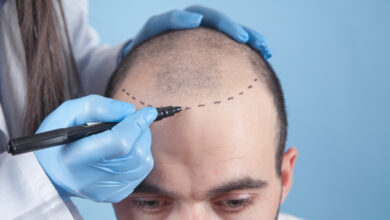
The frontal hairline, mid-scalp and crown are different planning zones. Ask the clinician to mark the area being treated, explain priorities and describe areas that will remain untreated. A quote for front-only restoration is not comparable with a quote covering the entire top of the scalp.
A planning illustration is area multiplied by a proposed graft density: 50 cm² multiplied by 30 grafts per cm² equals 1,500 grafts. This is arithmetic only, not a recommended density or personal estimate. The appropriate area and density must come from the clinician’s assessment.
Donor capacity is a limit, not a package feature
Previous extraction matters. An ISHRS clinical discussion of repeat FUE stresses assessing what has already been harvested and the remaining density. It does not support choosing the next session’s count solely from a photograph or a fixed advertising package.
Ask how the donor was measured and what should remain available for future procedures. Read our donor-area guide and overharvesting guide before comparing very large offers.
Why the same count can look different
Ask the surgeon how hair characteristics, distribution and styling will affect the coverage you can expect. Look at cases with comparable starting conditions rather than treating the highest graft number as the best result.
Our patient archive can support discussion of individual plans. It is not a controlled dataset and should not be used to calculate a clinic’s success rate.
How to compare three quotes
| Field | What to request |
|---|---|
| Treatment area | Marked zones and coverage priorities |
| Count | Grafts versus hairs; preliminary versus final plan |
| Donor | Assessment, previous harvesting and future reserve |
| Price | Package limit, extra charges and written inclusions |
| Responsibility | Who assesses and performs each stage |
Using a calculator responsibly
The Hair Transplant Planner gives an educational range from limited inputs. It does not measure donor density, diagnose hair loss or approve surgery. Use the output to organise questions; do not interpret it as confirmation that a requested number is safe.
Before paying, ask what happens if the examination changes the estimate and whether the price or treatment area changes. This matters more than achieving a predetermined number on the day.
Practical takeaway: Compare the assumptions behind graft estimates and seek an in-person donor assessment before accepting a proposed count.
What changes a graft estimate at an in-person consultation?
A useful estimate has to describe a plan, not just a quantity. Ask the clinician to draw the proposed recipient zones on a scalp photograph and identify which zones are priorities. A front-only plan, a crown-only plan and a combined plan may all use similar total numbers while offering very different visual outcomes. Ask whether the estimate assumes existing hair will remain stable or whether continued thinning has been considered.
Hair calibre, curl, colour contrast with the scalp and the distribution of existing hair affect how coverage looks. This is why an online photograph or a calculator cannot determine an individual graft requirement. Two quotes that appear to offer the same number of grafts might still describe different surgical approaches.
Compare a number with the assumptions behind it
| Question | Why it matters | Evidence to request |
|---|---|---|
| Which zones receive the grafts? | A total count does not show the balance between hairline, mid-scalp and crown. | A marked area diagram and planned allocation. |
| How was donor availability assessed? | Hair extraction changes the donor area and may limit future surgery. | An examination summary, including prior harvesting. |
| Is the number preliminary? | An in-person assessment can change the appropriate plan. | The process for revising the count and price. |
| Who does each surgical stage? | Responsibility for assessment and surgery should be clear. | Names, qualifications and written responsibilities. |
A practical example of why the highest number is not always preferable
Imagine one proposal prioritises the frontal hairline, while another spreads the available grafts across both the front and crown. The second proposal could advertise a larger count yet produce less visible density in the front. Neither proposal is automatically better: they answer different priorities and must be judged against donor constraints and likely future loss. Ask each clinic to explain the trade-off in writing before comparing prices.
The American Academy of Dermatology’s patient guide emphasises healthy donor hair, scalp examination and realistic expectations when considering transplantation. Use that framework to judge a quote instead of treating a calculator result as a clinical prescription.
A quote comparison worksheet
Before comparing totals, ask each clinic to complete the same planning fields. This makes different proposals easier to evaluate and exposes what a headline graft count leaves out.
| Planning field | Record for each consultation |
|---|---|
| Diagnosis and pattern | What cause and stage does the clinician document? |
| Recipient map | Which zones are treated, and what is the priority order? |
| Count definition | Grafts, hairs or an estimate; what is the final counting method? |
| Donor assessment | What was examined, including prior procedures and future reserve? |
| Team and price | Who performs each stage; what is included and excluded? |
Two plans with the same graft total may allocate them differently and aim for different coverage. The ISHRS donor-harvesting discussion compares the trade-offs of current harvesting approaches; the AAD guide reinforces the need for examination and realistic expectations. A calculator can organise questions but cannot prescribe a safe number.
Sources and editorial information
Sources checked: 13 October 2026. Read our editorial approach. This is an educational overview, not a diagnosis or a personalised postoperative or medication plan.