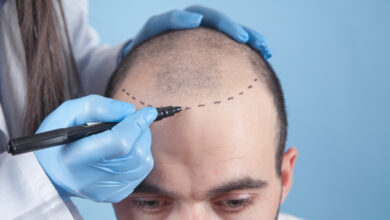
What is the Donor Area and Why It’s So Important for Hair Transplants?

The donor area sets the practical limits of a hair transplant. It is the part of the scalp from which healthy follicular units are taken and moved to thinning or bald areas. Because those follicles are being redistributed rather than created, the donor supply needs to be treated as a finite resource from the start.
What is the donor area?
Questions for consultation: How was the safe donor zone identified? Were density and miniaturization examined? What extraction distribution is planned, and how much reserve will remain if hair loss progresses? A quoted graft count alone cannot answer these questions. Compare the proposed plan using our clinic checklist.
For most scalp transplants, the donor zone is the back and sides of the head. Hair in these areas is often more resistant to androgenetic hair loss, but that does not mean every part of the donor region is equally stable.
Donor assessment considers density, hair calibre, miniaturization, previous extractions and the likely course of future hair loss. The ISHRS FUE Clinical Practice Guidelines (2019) recommend measuring density in multiple donor locations and identifying the safe donor area. These findings help determine graft availability, achievable coverage and whether FUE is suitable.

Why is the donor area so important?
A hair transplant can only move the follicles that are already available. That means donor quality affects not only the first procedure, but also whether future surgery remains possible if hair loss continues.
Limited supply: Donor hair is finite. Once follicular units are removed, they are not replaced, so extraction should be planned conservatively.
Quality matters: Low density, miniaturization or weak donor characteristics can limit the number of grafts that can be safely harvested.
Natural results: Hair calibre, curl, color contrast and graft placement all affect how well transplanted hair blends with existing hair.
A stable donor area generally gives the surgical team more flexibility for long-term planning.
Can the donor area be too weak?
Yes. Advanced hair loss, diffuse thinning and miniaturization in the donor zone can all reduce the number of grafts that can be harvested safely. Previous transplant sessions can also leave less room for another procedure.
This is why a graft estimate should not be treated as final before the donor area has been examined. In some cases, the safest advice is to reduce the planned coverage, stage the procedure over time or avoid surgery altogether.
How is the donor area assessed?
A useful donor assessment is more than a quick look at the back of the head. Clinics may consider density, hair calibre, miniaturization, previous extraction history and hair characteristics before deciding how much can be harvested safely.
Practical donor assessment checklist
- Map donor density: Ask whether density has been checked across the proposed extraction zone rather than estimated from photographs alone.
- Check miniaturization: Ask whether thinning within the donor zone could make long-term graft survival less predictable.
- Review prior procedures: Disclose previous FUE or FUT surgery, scars and any areas of visible overharvesting.
- Discuss lifetime supply: Ask how the plan preserves grafts if hair loss progresses or future surgery becomes necessary.
- Clarify limits: Request an explanation of the safe extraction range, expected coverage and alternatives if donor supply is insufficient.
A clinician should examine the scalp directly or with appropriate magnification before providing a definitive surgical plan. Photos and online calculators can support an initial discussion, but cannot measure donor reserve reliably.
Potential donor-area risks
FUE can leave small scars and visible thinning, particularly when grafts are harvested too densely. Temporary discomfort or changes in sensation may occur; some complications require clinical assessment. A qualified surgeon should explain individualized risks, including whether a different treatment or no surgery is preferable.
Donor Supply and Future Hair Loss
Hair loss can continue in untreated areas after transplantation. A conservative plan considers the possibility of future procedures, the patient’s age and expected pattern of progression. The number of grafts that can be removed safely cannot be determined from an online photograph or a universal formula; it requires an individual scalp assessment.
Questions About Donor-Area Recovery
After FUE, small extraction sites usually heal over time, but the removed follicular units do not regrow in their original positions. Residual redness, visible dot scars or uneven density may be more apparent with very short hairstyles. Ask the surgical team about realistic healing, scar visibility and care instructions for the donor area.
Final thoughts
The donor area is the main biological resource available for scalp transplantation. Preserving it is essential for both the first procedure and any future surgery.
There is no unlimited donor supply, so realistic coverage goals and conservative extraction are central to long-term planning.
For broader planning, see our patient reviews guide, clinic comparison guide and Hair Transplant Planner.
Frequently asked questions
Does hair grow back in the donor area after FUE?
No. The extracted follicular units are permanently moved. Hair around the extraction points continues to grow, which is why careful spacing and donor planning are important.
Can an overharvested donor area be repaired?
Sometimes the appearance can be improved, but repair options are limited. This is one reason conservative extraction is preferable from the beginning.
Is a strong donor area enough to guarantee a good result?
No. Donor strength is only one part of the plan. Hairline design, graft handling, recipient-site creation and realistic expectations also matter.
Can the donor area run out?
Yes. Because the supply is finite, repeated or overly aggressive procedures can leave too little donor hair for future work.
Sources and editorial information
Selected sources for donor evaluation and revision considerations: ISHRS: FUE Clinical Practice Guidelines (2019), donor evaluation and management; ISHRS: Revision and Repair of Bad Hair Transplants.
Sources checked: 19 October 2026. This is an editorial source update, not a medical review by a doctor. These educational sources do not establish a personal graft limit or guarantee a surgical outcome. Read our editorial approach.