Hair Transplant: 15 Common Questions Answered

Hair Transplant: 15 Questions You Should Ask Before Surgery
Hair transplantation can look simple from the outside: hair is taken from one area and moved to another.
In reality, it is a surgical procedure that requires careful diagnosis, donor-area planning, appropriate technique and realistic expectations.
Before booking a procedure, patients should understand what a hair transplant can achieve, what it cannot do, how recovery works and what risks are involved.
Here are 15 of the most important questions to ask before surgery.
1. What Is a Hair Transplant?
A hair transplant is a surgical procedure that moves hair follicles from a donor area to an area affected by thinning or baldness.
The donor area is usually located at the back and sides of the scalp.
These follicles are selected because they are generally more resistant to the hormonal effects associated with androgenetic alopecia.
The NHS describes hair transplantation as a procedure that moves hair to areas that are thin or bald. nhs.uk
The aim is not to create new follicles.
Instead, existing follicles are redistributed.
2. Who Is a Good Candidate for Hair Transplantation?
A good candidate generally has:
- A clear diagnosis
- Stable or reasonably predictable hair loss
- Adequate donor hair
- Realistic expectations
- Healthy scalp tissue
- No active condition likely to interfere with healing
Hair transplantation is commonly used for permanent hereditary hair loss.
However, it may not be suitable for every type of hair loss.
For example, the NHS notes that transplantation is generally not suitable for conditions such as active alopecia areata, which causes patchy hair loss. nhs.uk
A proper diagnosis should come before deciding on surgery.
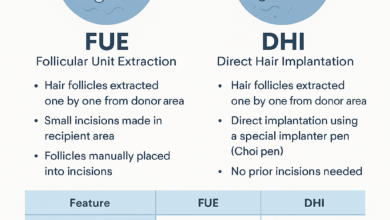
3. What Is the Difference Between FUE and DHI?
FUE and DHI are often advertised as completely different procedures.
That is not entirely accurate.
FUE primarily describes how follicular units are removed from the donor area.
DHI generally describes how harvested grafts are implanted using an implanter device.
ISHRS specifically states that DHI should not be considered a separate hair transplant method by itself. ISHRS
In many DHI procedures, grafts are still extracted using FUE.
You can read more in our FUE vs DHI Hair Transplant guide.
4. Is Hair Transplant Painful?
Hair transplantation is generally performed under local anesthesia.
The most uncomfortable part for many patients is the injection of the anesthetic.
Once the scalp is numb, patients may feel:
- Pressure
- Movement
- Pulling
- Vibration
Significant sharp pain should not normally occur during the procedure.
After surgery, soreness, tightness and swelling may occur for several days.
A 2025 systematic review found pain and discomfort among the most frequently reported postoperative complaints, although hair transplantation was generally considered safe. PubMed
You can read our detailed guide: Is Hair Transplant Painful?
5. How Many Grafts Will I Need?
There is no universal graft number.
The correct number depends on:
- Size of the thinning area
- Donor density
- Hair diameter
- Hair color
- Scalp contrast
- Hair-loss pattern
- Hairline design
- Existing native hair
- Long-term donor capacity
A clinic should not recommend a large graft number simply because it sounds impressive.
The donor area contains a limited number of follicles.
Using too many grafts in one session can reduce options for future procedures.
6. Can Too Many Grafts Be Taken?
Yes.
This is known as overharvesting.
If too many follicular units are removed from the donor area, the back and sides of the scalp can appear:
- Thin
- Patchy
- Uneven
- Moth-eaten
- Permanently depleted
ISHRS warns that poorly performed FUE can cause diffuse donor thinning and visible scarring. ISHRS
A 2026 review also identifies donor depletion as a recognized complication of FUE. PubMed
Donor preservation should therefore be part of every treatment plan.
7. Does FUE Leave Scars?
Yes.
FUE does not normally produce the long linear scar associated with FUT strip surgery.
However, it is not completely scarless.
Each extraction creates a small circular wound.
These usually heal as tiny dot-like scars that may be difficult to see when extraction is properly distributed.
ISHRS specifically warns against marketing FUE as a “no scar” procedure. ISHRS
8. Are Hair Transplant Results Permanent?
Transplanted follicles generally retain many characteristics of the donor area.
However, this does not mean that the entire appearance will remain unchanged forever.
Native hair surrounding the transplant may continue to thin.
The NHS specifically notes that hair can continue thinning around transplanted areas and that the transplant should be designed with future changes in mind. nhs.uk
This is why long-term planning is especially important for younger patients.
9. When Will the Transplanted Hair Start Growing?
Hair transplantation results take time.
A general timeline may look like this:
First 1–2 Weeks
Crusting, redness and mild swelling gradually improve.
First Few Weeks
Many transplanted hairs may shed.
This does not necessarily mean the follicles have failed.
Around 3–4 Months
Early new growth may begin.
6–9 Months
The cosmetic improvement usually becomes more noticeable.
10–18 Months
A substantial portion of the final result may become visible.
The NHS notes that new hair often begins appearing after several months and that full results may take approximately 10 to 18 months. nhs.uk
10. Will All Transplanted Grafts Survive?
No clinic can guarantee that every graft will grow.
Graft survival can be affected by:
- Extraction trauma
- Dehydration
- Storage conditions
- Time outside the body
- Implantation trauma
- Blood supply
- Patient healing
- Smoking
- Postoperative care
Claims of guaranteed 100% graft survival should be treated cautiously.
The goal should be careful graft handling and realistic expectations rather than guaranteed percentages.

11. What Are the Risks of Hair Transplant Surgery?
Hair transplantation is generally considered safe, but it is still surgery.
Possible risks include:
- Pain
- Swelling
- Bleeding
- Infection
- Folliculitis
- Temporary numbness
- Shock loss
- Scarring
- Poor growth
- Unnatural hairline
- Donor overharvesting
- Uneven density
The NHS lists bleeding, infection and reactions to anesthesia among possible surgical complications. nhs.uk
A recent systematic review also found that complications can occur at both donor and recipient sites, although serious problems are relatively uncommon. PubMed
Rare but more serious complications, such as recipient-site necrosis, have also been reported. PubMed
12. What Is Shock Loss?
Shock loss refers to temporary shedding after surgery.
It can affect:
- Transplanted hairs
- Native hairs around the recipient area
- Occasionally donor-area hairs
In many cases, the shedding is temporary.
However, existing miniaturized hairs may sometimes fail to recover completely.
Patients with diffuse thinning should discuss this risk before surgery.
13. How Long Is Recovery?
For a detailed timeline, see our Hair Transplant Recovery Timeline.
Most patients return to normal daily activities relatively quickly.
Typical recovery may include:
- Swelling for several days
- Crusting for approximately 1–2 weeks
- Temporary tenderness
- Temporary redness
- Restrictions on exercise
- Special washing instructions
The NHS advises that grafts require particular care during the first two weeks and that patients may need one to two weeks away from work, depending on the procedure and circumstances. nhs.uk
Exact instructions vary by clinic.
14. How Do I Choose a Hair Transplant Clinic?
Do not choose based only on:
- Price
- Hotel package
- Graft number
- Instagram followers
- FUE or DHI marketing
- Before-and-after photos
Instead, ask:
- Who is the responsible doctor?
- Who performs the extraction?
- Who creates the recipient sites?
- Who implants the grafts?
- How many patients are treated each day?
- How is the donor area evaluated?
- What happens if complications occur?
- What aftercare is provided?
- Can I see comparable patient results?
ISHRS recommends confirming that the physician is genuinely involved in the surgery rather than delegating surgical steps to unlicensed technicians. ISHRS
The NHS also recommends checking qualifications, experience, complication history and follow-up arrangements. nhs.uk
You can read our full guide: How to Choose a Hair Transplant Clinic.
15. How Much Does a Hair Transplant Cost?
There is no universal price.
Cost depends on factors such as:
- Country
- Clinic
- Surgeon involvement
- Number of grafts
- Technique
- Procedure length
- Additional treatments
- Hotel and transport packages
Turkey is popular because prices can be lower than in many Western countries, but price should not be the main factor when choosing a clinic.
A cheap procedure that damages the donor area can become much more expensive to correct later.
Ask exactly what the price includes.
Is Hair Transplant Worth It?
For a suitable patient, hair transplantation can produce a significant cosmetic improvement.
But it is not a cure for progressive hair loss.
A good result depends on:
- Correct diagnosis
- Appropriate candidate selection
- Careful donor management
- Natural hairline design
- Proper graft handling
- Long-term planning
The best question is not:
“Which clinic offers the most grafts?”
It is:
“Which treatment plan gives me the best long-term result while protecting my donor area?”
Frequently Asked Questions
Can transplanted hair fall out?
The hair shafts commonly shed during the first few weeks after surgery. New growth can later emerge from the transplanted follicles.
Can hair transplantation stop future baldness?
No. It redistributes follicles but does not stop androgenetic alopecia in untreated native hair.
Is DHI better than FUE?
Not automatically. DHI generally refers to an implantation approach, while FUE describes follicular-unit harvesting.
Can I have a second hair transplant?
Possibly, provided sufficient donor hair remains.
Does hair transplant work for women?
Yes, selected women can be good candidates. Diagnosis and donor stability are especially important.
Can PRP improve hair transplant results?
PRP may be used as an adjunct by some clinics, but it is not required for a successful transplant and should not compensate for poor surgical technique.PRP for Hair Loss: How It Works, Results, Sessions & Risks
Can completely bald areas be restored?
Hair can potentially be transplanted into bald areas, but the achievable density depends on available donor supply and the size of the recipient area.
Is hair transplantation safe?
It is generally considered safe when properly performed, but complications are possible and should be discussed before surgery. PubMed
Final Thoughts
A hair transplant is not simply about moving as many grafts as possible.
The procedure should be planned around:
Your diagnosis.
Your donor capacity.
Your current hair loss.
Your future hair loss.
Natural hairline design.
Safe surgical technique.
Realistic expectations.
A responsible clinic should be willing to explain all of these issues before you make a decision.
Take time to understand the procedure, compare clinics carefully and do not allow price or marketing terminology to replace proper medical evaluation.