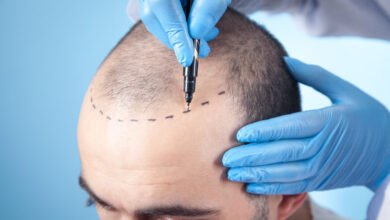
FUT vs FUE Hair Transplant: Scars, Grafts, Recovery & Which Is Better?

FUT and FUE are the two main methods used to harvest donor hair for a hair transplant. Both can produce natural-looking results when the patient is properly selected and the procedure is planned well, but they differ significantly in how grafts are removed, how the donor area heals and how future donor hair can be managed.
The most important point is that neither technique is universally better. FUE is now more common in many clinics because it avoids a linear donor scar and usually allows a shorter haircut. FUT, however, can still be a useful option in selected patients, especially when maximizing lifetime graft availability is a priority.
This guide compares FUT vs FUE from a practical patient perspective: scars, graft numbers, recovery, donor management, pain, cost and who may benefit from each approach.
FUT vs FUE at a Glance
| Factor | FUE | FUT |
|---|---|---|
| How grafts are harvested | Follicular units are removed individually with small punches | A strip of donor scalp is removed and dissected into follicular units |
| Donor scar | Many small round scars distributed across the donor area | One linear scar |
| Stitches | Usually not required in the donor area | Usually required to close the strip incision |
| Short hairstyles | Usually more compatible with very short hair | The linear scar may become visible with very short hair |
| Early donor-area recovery | Often faster | May involve more tightness or discomfort during early healing |
| Large lifetime graft needs | Can be effective, but donor extraction must be carefully distributed | May preserve additional donor options in selected high-graft-demand patients |
| Need to shave donor area | Often yes, although partial-shave approaches exist | A large shave may not always be necessary |
The International Society of Hair Restoration Surgery (ISHRS) recognizes both FUE and FUT as current donor-harvesting approaches. The right choice depends on the patient rather than the marketing popularity of a technique.
The Real Difference Is How Donor Hair Is Removed
FUE and FUT do not describe two completely different types of hair growth. In both procedures, follicular units are moved from a donor area—usually the back and sides of the scalp—to areas affected by hair loss.
The main difference is how those follicular units are harvested.
FUE: Individual Follicular Unit Excision
In FUE, follicular units are removed one by one with a small circular punch. Each extraction creates a tiny wound that heals individually.
This means there is no single linear incision across the donor area. Instead, small scars are distributed throughout the harvested zone.
FUE is sometimes advertised as “scarless,” but this is inaccurate. Any surgical incision that enters the skin can create scar tissue. The cosmetic advantage of FUE is that the scars are usually small and scattered rather than concentrated in one line.

FUT: Strip Harvesting
In FUT, also known as strip surgery, a narrow strip of hair-bearing scalp is surgically removed from the donor area. The wound is then closed, usually with sutures or staples, leaving a linear scar.
The strip is dissected under magnification into individual follicular-unit grafts before implantation.
FUT is older than modern FUE, but “older” does not automatically mean obsolete. The ISHRS continues to describe FUT as a valid surgical option for appropriately selected patients.
Scarring: The Most Visible Difference
Scarring is often the deciding factor for patients comparing FUT vs FUE.
FUE Scars
FUE creates many small circular scars. When extraction is evenly distributed and donor density is respected, these scars may be difficult to notice even with relatively short hair.
However, aggressive extraction can produce visible donor thinning or a “moth-eaten” appearance. This is why a high graft number should never be treated as automatically better.
FUT Scar
FUT creates a single linear scar in the donor area. In a well-healed case, longer hair can often conceal it. The scar may become more visible with very short or shaved hairstyles.
Scar width also varies between patients because healing characteristics, scalp tension and surgical technique differ.
If wearing the hair extremely short is important to you, FUE usually has the cosmetic advantage.
Which Technique Can Provide More Grafts?
This question is more complicated than simply asking which method can remove the largest number of grafts in one day.
The donor area is a limited biological resource. A responsible plan must consider not only the first procedure but also possible future hair loss and future surgeries.
FUT can be useful in patients who may need a large number of grafts over their lifetime because strip harvesting can preserve areas that may later be used for FUE. In some advanced cases, surgeons may use both techniques at different stages to maximize available donor hair.
FUE can also provide large sessions, but excessive extraction from the donor area may permanently reduce visible density.
The correct question is therefore not:
“How many grafts can the clinic take?”
It is:
“How many grafts can be removed safely while preserving my donor area for the future?”
Recovery: FUE Usually Has an Easier Donor-Site Recovery
Because FUE does not involve removing a strip of scalp or closing a long incision, early donor-area recovery is often easier.
Patients may still experience:
- redness
- tenderness
- small crusts
- temporary numbness or sensitivity
With FUT, the linear incision can create more tightness or discomfort during the first days after surgery. Physical activity may also need to be restricted while the wound heals.
Recovery varies by patient, so neither method should be described as completely painless or risk-free.
For a broader explanation of discomfort during and after surgery, see our Is Hair Transplant Painful? guide.
Does FUE Produce Better Hair Growth?
Not automatically.
Once a healthy follicular-unit graft has been harvested and implanted correctly, the final result depends on much more than whether the donor graft came from FUE or FUT.
Important factors include:
- patient selection
- donor quality
- graft handling
- hairline design
- recipient-site angle and direction
- implantation technique
- surgeon and team experience
- postoperative care
A poorly planned FUE procedure can produce a worse result than a well-performed FUT procedure, and the reverse is also true.
FUE May Be Better for Patients Who…
- prefer to wear their hair short
- want to avoid a linear donor scar
- have a relatively limited graft requirement
- want a quicker early donor-site recovery
- have already had FUT and need additional grafts from outside the strip scar
- are suitable for selective beard or body-hair harvesting when scalp donor supply is limited
Suitability still depends on donor density, hair characteristics and the pattern of hair loss.
FUT May Still Be Worth Considering If…
- you have a high lifetime graft requirement
- you normally keep the donor hair long enough to hide a linear scar
- your scalp laxity and donor characteristics are appropriate
- you want to preserve additional FUE options for later procedures
- your surgeon believes strip harvesting offers an advantage for your long-term donor plan
FUT should not be dismissed only because FUE is more heavily marketed.
Can FUT and FUE Be Combined?
Yes. Some patients undergo FUT first and use FUE later, while selected patients may benefit from a combined or staged approach.
This can be useful when a patient has extensive hair loss and needs to maximize the number of grafts available over many years.
The decision should be based on a long-term donor-management strategy rather than on a single-session graft target.
What About DHI and Sapphire FUE?
DHI and Sapphire FUE are often presented as alternatives to FUE, but the terminology can be confusing.
FUE primarily describes how grafts are harvested. DHI usually refers to an implantation approach using an implanter pen, while Sapphire FUE generally refers to creating recipient sites with sapphire blades.
For this reason, a procedure can involve FUE extraction followed by DHI implantation.
See our detailed FUE vs DHI Hair Transplant comparison if you are deciding between those terms.
What About Pain?
Both FUT and FUE are normally performed under local anesthesia.
Patients often notice the anesthetic injections more than the harvesting itself once the scalp is numb.
After surgery, FUT may produce more donor-area discomfort because a strip of scalp has been removed and the wound has been closed. FUE often causes less early donor-site discomfort, although tenderness can still occur.
What About Cost?
Price should not be the main factor when choosing between FUT and FUE.
FUE can be more labor-intensive because follicles are removed individually, but pricing structures vary widely between countries and clinics. Some clinics charge by graft, while others use package pricing.
If you are comparing treatment in Turkey, see our Hair Transplant Cost in Turkey guide.
Why Is FUE More Common in Turkey?
FUE has become the dominant technique in many Turkish hair transplant clinics because international patients often prefer:
- no linear donor scar
- shorter hairstyles
- large single-day sessions
- faster early donor recovery
- package-based medical tourism
That popularity does not make every FUE clinic equally good.
High-volume treatment can create problems when donor extraction is too aggressive or when key surgical steps are not properly supervised.
If you are considering treatment abroad, read our Hair Transplant in Turkey guide and our checklist on How to Choose a Hair Transplant Clinic.
Questions to Ask Before Choosing FUT or FUE
Instead of asking a clinic only which technique it recommends, ask:
- What is my donor density?
- How many grafts can safely be harvested now?
- How much donor reserve should remain for future hair loss?
- Why are you recommending FUE or FUT for me?
- What type of donor scar should I expect?
- Who performs the harvesting?
- What punch size is used for FUE?
- How is overharvesting prevented?
- If FUT is recommended, how long is the expected linear scar?
- Could I need another transplant later?
A clinic that cannot clearly explain its donor strategy should not be chosen based only on price or graft count.
FUT vs FUE: Which Is Better?
For many modern patients, FUE is the more convenient option because it avoids a linear scar and usually fits better with shorter hairstyles and faster early recovery.
But that does not mean FUT is medically inferior.
FUT can remain valuable for selected patients with high graft requirements, good scalp characteristics and a long-term plan that prioritizes maximum donor utilization.
The best technique is the one that matches your donor area, hair-loss pattern, hairstyle preferences and likely future needs.
A good hair transplant plan should protect the donor area first and maximize graft numbers second.