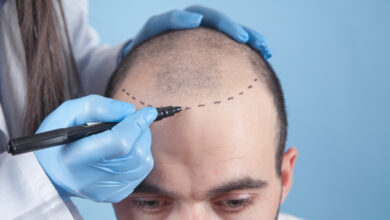
When Does Male Hair Loss Begin? Early Signs & Causes

Male-pattern hair loss, also called androgenetic alopecia, is the most common type of hair loss in men. It is influenced by genetics and sensitivity to androgens, including dihydrotestosterone (DHT). It usually develops gradually, but the age at which it begins can vary considerably from one person to another.
At What Age Does Male Hair Loss Usually Begin?
Male-pattern hair loss can start after puberty and, in some men, becomes noticeable in the late teens or early 20s. For many others, the first visible changes appear later. The likelihood of developing androgenetic alopecia increases with age, so there is no single “normal” age at which male hair loss begins.
What matters most is the pattern of change. A slowly receding hairline, gradual thinning at the temples, or reduced density at the crown is more typical of male-pattern hair loss than sudden shedding across the entire scalp.

What Are the Early Signs of Male-Pattern Hair Loss?
Early androgenetic alopecia commonly affects the frontal hairline, temples and crown. Typical signs include:
- gradual recession at one or both temples;
- a hairline that becomes more M-shaped over time;
- progressive thinning through the frontal scalp;
- a widening thin area or bald spot at the crown; and
- individual hairs in affected areas becoming finer and shorter.
These changes usually occur over months or years rather than days or weeks.
Why Does Male-Pattern Hair Loss Happen?
In genetically susceptible follicles, androgen activity can shorten the hair-growth phase and gradually miniaturize the follicle. New hairs become finer and shorter over time. Family history can increase the likelihood of developing patterned hair loss, but inheritance is complex and cannot be predicted from only one side of the family.
Not Every Type of Hair Loss Is Male-Pattern Baldness
Hair loss can also be associated with illness, major physical or emotional stress, rapid weight loss, nutritional deficiencies, medications, autoimmune conditions or inflammatory scalp disorders. Diffuse shedding or sudden patchy loss therefore should not automatically be assumed to be androgenetic alopecia.
When Should You Get Hair Loss Checked?
Consider a medical assessment if hair loss is sudden, patchy, unusually rapid, or accompanied by redness, scaling, itching, pain or broken hairs. A clinician can help determine whether the pattern is consistent with androgenetic alopecia or whether another cause should be investigated.
Does Starting Treatment Early Matter?
If the diagnosis is male-pattern hair loss and treatment is appropriate for you, starting earlier may help preserve more existing hair because progressive follicle miniaturization becomes harder to reverse over time. Treatment choice depends on your age, health history, degree of hair loss and goals, so medication decisions should be discussed with a qualified healthcare professional.
How to Track Changes Over Time
Photograph the front, temples and crown at regular intervals in similar lighting and with similar hair length. Consistent photographs can help a clinician distinguish gradual patterned thinning from a temporary change. They cannot establish a diagnosis on their own.
What to Expect From Hair-Loss Treatment
Responses vary by diagnosis and individual factors. Treatments for androgenetic alopecia generally aim to slow further loss and, in some patients, improve density; they do not guarantee full restoration. Medical options, adverse effects and suitability should be reviewed with a clinician, particularly when shedding is sudden or the scalp is inflamed.
Why Consistent Photographs Matter
Hair density can appear different after a haircut, when wet, or under strong lighting. To track possible progression, photograph the frontal hairline, temples and crown from consistent positions over several months. Pictures are useful context but are not a substitute for examining the scalp and assessing the cause of loss.
Questions to Discuss With a Dermatologist
- Is my hair loss consistent with androgenetic alopecia or another condition?
- Would scalp examination or targeted testing help clarify the diagnosis?
- What treatment options match my age, health history and goals?
- How should we assess changes over time?
For related information, see our finasteride results guide and hair-loss treatment overview.