DHI Hair Transplant: How It Works, Pros, Cons, Cost & Recovery

DHI Hair Transplant: How It Works, Advantages, Risks & Recovery
DHI hair transplant is one of the most heavily marketed hair restoration techniques, especially in Turkey.
The term DHI usually stands for Direct Hair Implantation.
It is often presented as an alternative to FUE, but this can be misleading.
In many DHI procedures, the grafts are still harvested using FUE. The main difference is how the extracted grafts are implanted into the recipient area.
Instead of placing grafts with forceps into previously created recipient sites, an implanter pen may be used to insert the follicles directly.
The International Society of Hair Restoration Surgery explains that DHI is not a separate hair transplant method in itself and should not be marketed as though it replaces FUE. ISHRS
This is the technical DHI guide. For Turkey-specific package examples, provider checks and travel planning, use our DHI in Turkey research guide.
What Is DHI Hair Transplant?
DHI is a term commonly used for hair transplantation where follicular grafts are implanted with an implanter device, often called a Choi-type implanter pen.
A typical DHI procedure may involve:
- Harvesting follicles from the donor area using FUE
- Examining and preparing the grafts
- Loading grafts into implanter pens
- Inserting the grafts into the recipient area
This means the patient may actually receive:
FUE extraction + DHI-style implantation.
Understanding this distinction is important when comparing clinics.
Is DHI Different From FUE?
Yes, but not in the way many advertisements suggest.
FUE
FUE describes how grafts are removed from the donor area.
Individual follicular units are extracted one by one.
DHI
DHI usually describes how the grafts are placed into the recipient area.
An implanter device is used for implantation.
Therefore, a procedure can use both FUE and DHI during the same surgery.
You can read our full FUE vs DHI Hair Transplant comparison for more detail.
How Does DHI Hair Transplant Work?
The exact technique varies by clinic, but the process usually includes several stages.
Step 1: Consultation
The medical team evaluates:
- Hair-loss pattern
- Donor density
- Hair calibre
- Scalp condition
- Medical history
- Previous hair transplants
A treatment plan and estimated graft number are then developed.
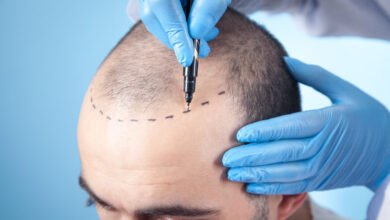
Step 2: Hairline Design
The proposed hairline is marked.
Hairline design should consider:
- Age
- Facial proportions
- Future hair loss
- Donor supply
- Existing hair
A very low hairline can consume unnecessary grafts.
Step 3: Local Anesthesia
Local anesthetic is administered to the donor area.
Patients may feel discomfort during the injections.
Once the area is numb, sharp pain should be significantly reduced.
Step 4: FUE Extraction
In many DHI procedures, grafts are harvested individually using FUE.
A small punch separates the follicular units from surrounding tissue.
The grafts are then removed and prepared.
Step 5: Loading the Implanter
Each follicular unit is carefully loaded into an implanter device.
This step requires careful graft handling.
Step 6: Implantation
The implanter is positioned at the desired:
- Angle
- Direction
- Depth
and the graft is inserted into the scalp.
What Is a Choi Implanter Pen?
A Choi-type implanter is a small instrument designed to hold and place a follicular graft.
Implanters may be:
- Sharp
- Dull
The ISHRS explains that dull implanters are used to place grafts into pre-made incisions, while sharp implanters can create the incision and implant the graft during the same movement. ISHRS
This means not every procedure described as DHI is performed in exactly the same way.
What Are the Potential Advantages of DHI?
Possible advantages may include:
Controlled Placement
The implanter can help control:
- Depth
- Direction
- Angle
These factors are important for natural-looking results.
Reduced Direct Graft Handling
The ISHRS notes that implanters may reduce direct handling of the hair bulb compared with forceps placement. ISHRS
Less unnecessary handling may theoretically reduce mechanical trauma to grafts.
Useful Between Existing Hairs
Implanter-assisted placement can sometimes be useful when working between existing native hairs.
This may be relevant for patients with thinning rather than completely bald recipient areas.
Unshaven Procedures
Some clinics use DHI implantation for selected partially shaved or unshaven hair transplant procedures.
However, this is not suitable for every patient.
Does DHI Produce Higher Density?
Not automatically.
Density depends on many factors, including:
- Donor availability
- Recipient-area size
- Hair calibre
- Graft survival
- Hairline design
- Surgical technique
- Existing hair
- Blood supply
Simply using an implanter pen does not guarantee greater density.
A poorly planned DHI procedure can still produce an unsatisfactory result.
Does DHI Have a Better Graft Survival Rate?
There is no universal percentage proving that all DHI procedures produce better graft survival than well-performed conventional FUE implantation.
Graft survival depends on:
- Extraction trauma
- Time outside the body
- Storage solution
- Dehydration
- Temperature
- Graft handling
- Implantation technique
- Surgical experience
The device itself is only one part of the process.
Does DHI Leave Scars?
DHI does not mean scarless hair transplantation.
If follicles are harvested using FUE, the donor area will have many small extraction sites.
The NHS describes FUE as removing individual grafts one by one and notes that it leaves multiple tiny scars, even though they may be difficult to notice. nhs.uk
The size and visibility of these scars depend on:
- Punch size
- Donor density
- Skin characteristics
- Extraction pattern
- Healing
Is DHI Less Painful Than FUE?
Not necessarily.
Both procedures generally involve local anesthesia.
The most uncomfortable stage for many patients is the anesthetic injection.
After anesthesia, patients often feel:
- Pressure
- Touch
- Movement
- Vibration
rather than sharp pain.
The NHS notes that hair transplantation is commonly performed under local anesthesia and sometimes sedation. nhs.uk
How Long Does DHI Hair Transplant Take?
DHI can take several hours.
Procedure length depends on:
- Graft number
- Number of implanters
- Surgical team
- Recipient-area size
- Complexity
Large procedures may take most of the day.
The NHS notes that hair transplant procedures commonly take a day and larger areas may require more than one session. nhs.uk
How Many Grafts Can Be Implanted With DHI?
There is no universal safe graft limit.
The appropriate number depends primarily on donor capacity.
Patients should be cautious when clinics promise very large numbers simply because a DHI procedure is being used.
The donor area is finite.
Overharvesting can create permanent thinning.
Is DHI Better for the Hairline?
DHI may offer useful control during implantation, but natural hairlines depend more on surgical planning than on the device.
Important factors include:
- Single-hair graft selection
- Irregular hairline pattern
- Natural direction
- Correct angle
- Appropriate density
- Age-appropriate placement
An implanter does not automatically create a natural hairline.
Is DHI Good for Crown Hair Transplantation?
It can be used in the crown.
However, crown transplantation can require many grafts because of the natural spiral pattern and large surface area.
The surgeon must consider:
- Crown size
- Hair direction
- Donor reserve
- Future hair loss
Using too many grafts in the crown can limit future options for the frontal area.
Is DHI Suitable for Women?
Potentially, yes.
Women with suitable donor density and permanent localized thinning may be candidates.
However, female hair loss should be properly diagnosed first.
Possible causes include:
- Female-pattern hair loss
- Telogen effluvium
- Iron deficiency
- Hormonal disorders
- Thyroid disorders
- Scarring alopecia
Not every form of female hair loss is suitable for surgery.
Read our full Hair Transplant for Women guide.
Who Is a Good Candidate for DHI?
Potential candidates may include patients with:
- Androgenetic alopecia
- Stable hair loss
- Adequate donor density
- Realistic expectations
- Suitable scalp health
DHI does not solve the problem of a weak donor area.
If donor supply is poor, changing the implantation tool cannot create additional follicles.
Who May Not Be a Good Candidate?
DHI may not be appropriate for people with:
- Active alopecia areata
- Severe diffuse donor thinning
- Certain scarring alopecias
- Unrealistic expectations
- Insufficient donor supply
- Uncontrolled scalp disease
The NHS also notes that hair transplantation is mainly suitable for permanent pattern baldness and is not generally suitable for conditions such as alopecia areata.

DHI vs Sapphire FUE
These terms describe different parts of the procedure.
Sapphire FUE
Usually refers to recipient-site creation using sapphire blades.
DHI
Usually refers to implantation using an implanter device.
Both techniques may still use FUE for donor harvesting.
The question should therefore not simply be:
“Which one is better?”
Instead ask:
Which implantation method is appropriate for my donor area and recipient pattern?
DHI vs Traditional FUE Implantation
A simplified comparison:
| Feature | DHI / Implanter | Conventional FUE Placement |
|---|---|---|
| Graft extraction | Usually FUE | FUE |
| Implantation | Implanter pen | Forceps into recipient sites |
| Recipient sites | May be simultaneous or pre-made | Usually pre-made |
| Angle control | Through implanter | Through incision + placement |
| Shaving | May allow selective unshaven cases | Usually shaved or partly shaved |
| Outcome | Depends on team and planning | Depends on team and planning |
Neither approach guarantees better results.
What Are the Risks of DHI?
DHI has many of the same risks as other hair transplant procedures.
Possible risks include:
- Bleeding
- Infection
- Swelling
- Pain
- Scabbing
- Temporary numbness
- Folliculitis
- Shock loss
- Poor graft growth
- Scarring
- Donor depletion
- Unnatural direction
- Unsatisfactory density
The NHS confirms that hair transplantation carries risks including bleeding, infection, anesthetic reactions, visible scarring and failure of some transplanted hair to survive. nhs.uk
What Is Shock Loss?
Shock loss refers to temporary shedding of transplanted or existing hair after surgery.
This can occur because the scalp has experienced surgical trauma.
In many cases, the affected follicles recover.
However, severely miniaturized native hairs may not always return.
What Is Donor Overharvesting?
Overharvesting occurs when too many follicles are removed from the donor area.
Possible consequences include:
- Visible thinning
- Uneven density
- Patchy appearance
- Permanent donor damage
DHI does not protect against overharvesting because the donor follicles are still usually extracted using FUE.

How Long Is DHI Recovery?
Recovery is generally similar to other FUE-based procedures.
A typical timeline:
Days 1–3
Redness, swelling and tenderness may occur.
Days 4–10
Crusting gradually begins to resolve.
Around 10–14 Days
The scalp usually looks significantly more healed.
Weeks 2–8
Many transplanted hairs may shed.
Months 3–6
New growth may begin to appear.
Months 6–12
Density gradually improves.
Months 12–18
The result may continue maturing.
The NHS states that transplanted grafts are particularly vulnerable during the first two weeks and that new hair commonly begins appearing after several months, with final results potentially taking 10–18 months. nhs.uk
When Can You Wash Your Hair?
Your clinic should provide detailed washing instructions.
Patients are typically advised to handle the recipient area gently during the early postoperative period.
The NHS notes that gentle hand washing may be possible around day six in some cases, although individual surgeon instructions should take priority. nhs.uk
When Can You Exercise?
Heavy exercise is generally restricted during early recovery.
Your surgeon may recommend avoiding strenuous activity for several weeks.
The NHS notes that patients may be advised to reduce exercise during the first month. nhs.uk
When Do DHI Results Become Visible?
DHI does not create immediate final density.
Most transplanted hairs initially shed.
New growth usually appears gradually.
Patients should expect improvement over months rather than weeks.
Final maturation may take more than a year.
Are DHI Results Permanent?
Transplanted follicles can provide long-lasting growth.
However, native hair around the transplanted area may continue thinning.
This is why the treatment plan should account for future hair loss.
The NHS specifically notes that surrounding hair can continue thinning and that transplant design should consider future progression. nhs.uk
How Much Does DHI Hair Transplant Cost?
DHI is often marketed at a higher price than standard FUE packages.
Pricing may depend on:
- Country
- Clinic
- Surgeon
- Graft number
- Doctor involvement
- Procedure length
- Package services
In Turkey, many clinics use fixed package pricing rather than charging strictly per graft.
For current pricing, see our Hair Transplant Cost in Turkey guide.
Is DHI More Expensive Than FUE?
Often, yes.
Possible reasons include:
- Implanter equipment
- Longer implantation time
- Additional staff
- More detailed graft loading
However, a higher price does not automatically mean a better result.
Is DHI Better Than FUE?
There is no universal answer.
This comparison is often misleading because FUE usually describes extraction while DHI describes implantation.
A well-performed FUE procedure with conventional placement may produce an excellent result.
A poorly planned DHI procedure may produce a poor result.
The experience of the medical team matters more than the marketing label.
Is DHI the Best Hair Transplant Technique?
No single hair transplant technique is best for every patient.
The ideal approach depends on:
- Donor quality
- Hair-loss pattern
- Recipient area
- Graft requirement
- Existing hair
- Surgeon experience
A responsible clinic should explain why a specific technique is recommended.
What Should You Ask a DHI Clinic?
Before booking, ask:
- Who performs the FUE extraction?
- Who designs the hairline?
- Who uses the implanter?
- Is the implanter sharp or dull?
- Are recipient sites pre-made?
- How many patients are treated each day?
- How is donor density calculated?
- Why is this graft number recommended?
- What happens if my hair loss progresses?
- What aftercare is included?
- What complications have you encountered?
- Can I see results from patients similar to me?
Red Flags
Be cautious if a clinic claims:
- DHI is completely scarless
- DHI guarantees 100% graft survival
- DHI always gives more density
- DHI creates unlimited grafts
- DHI is suitable for everyone
- No doctor needs to be involved
- Results are guaranteed
No implantation device can eliminate biological variability.
Frequently Asked Questions
What does DHI stand for?
DHI usually stands for Direct Hair Implantation.
Is DHI different from FUE?
Yes, but they usually describe different stages. FUE describes extraction, while DHI commonly describes implanter-based placement. ISHRS
Does DHI use FUE extraction?
In many cases, yes.
Does DHI leave scars?
If FUE is used for harvesting, multiple small donor scars can remain. nhs.uk
Is DHI painful?
The procedure is usually performed under local anesthesia, so discomfort is often greatest during anesthetic injections. nhs.uk
Is DHI better for density?
Not automatically. Density depends on donor capacity, planning and surgical execution.
Is DHI suitable for women?
It can be suitable for selected women with an appropriate diagnosis and adequate donor supply.
When does DHI hair start growing?
New growth commonly begins after several months, with maturation continuing for up to 12–18 months. nhs.uk
Is DHI permanent?
Transplanted follicles can provide long-lasting growth, but surrounding native hair may continue thinning.
Is DHI safer than FUE?
There is no simple reason to consider DHI inherently safer. It shares many of the same surgical risks as other hair transplant procedures.
Final Thoughts
DHI hair transplantation is best understood as an implantation approach, not as a completely separate alternative to FUE.
In many cases:
FUE is used to harvest the grafts.
An implanter pen is used to place them.
The ISHRS specifically cautions that DHI should not be marketed as a separate hair transplant method. ISHRS
For patients, the most important questions are not:
“Is DHI better?”
but:
Who performs the surgery?
How is the donor area protected?
Why is the proposed graft number appropriate?
How will the grafts be handled?
How will future hair loss be managed?
Technique matters, but surgeon judgment and treatment planning matter more.