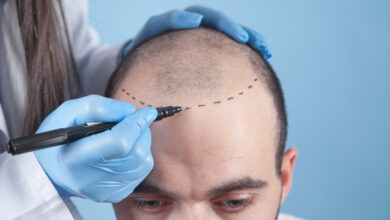
PRP for Hair Loss: How It Works, Results, Sessions & Risks

What Is PRP for Hair Loss? How It Works, Results, Sessions & Risks
Platelet-rich plasma, commonly known as PRP, is a treatment that uses a concentrated portion of a patient’s own blood and is increasingly used in hair-loss treatment.
PRP is often offered for androgenetic alopecia, also known as male or female pattern hair loss, and may also be used as a supportive treatment before or after hair transplantation.
It is important to understand what PRP can and cannot do.
PRP does not create an unlimited number of new hair follicles, and it is not a replacement for a hair transplant in patients with advanced bald areas. Its main role is to potentially support existing follicles and improve hair density or thickness in suitable patients.
What Is PRP?
PRP stands for Platelet-Rich Plasma.
Blood contains several components, including:
- Red blood cells
- White blood cells
- Plasma
- Platelets
Platelets are best known for their role in blood clotting, but they also contain growth factors and signaling molecules involved in tissue repair and healing.
During PRP preparation, a small amount of blood is taken from the patient and processed, usually in a centrifuge, to produce plasma containing a higher concentration of platelets.
This concentrated plasma is then injected into selected areas of the scalp.
How Is PRP Prepared?
Although protocols vary between clinics, a typical PRP procedure includes several steps.
1. Blood Collection
A small amount of blood is drawn from the patient.
2. Centrifugation
The blood is placed in a centrifuge.
The spinning process separates different blood components according to density.
3. PRP Preparation
The platelet-rich portion is collected.
Different systems can produce different concentrations of platelets and different amounts of white blood cells.
4. Scalp Injection
The prepared PRP is injected into areas affected by thinning hair.
This variability in preparation is one reason why results from different PRP studies are difficult to compare directly.
How Does PRP Help Hair Growth?
The exact mechanisms are still being investigated.
PRP contains growth factors and signaling molecules that may influence:
- Hair follicle cells
- Dermal papilla cells
- Blood vessel formation
- Tissue repair
- Inflammatory pathways
- Hair growth-cycle activity
The goal is generally to support follicles that are still present but weakened or miniaturized.
PRP cannot reliably recreate follicles that have completely disappeared from a long-standing bald area.
Does PRP Actually Work for Hair Loss?
Research suggests that PRP can improve some hair-growth outcomes in selected patients, particularly those with androgenetic alopecia.
A 2025 systematic review and meta-analysis included 43 randomized controlled trials involving 1,877 participants. The authors reported improvements in outcomes including hair density and clinical measures, although treatment protocols varied substantially between studies. Springer
An earlier systematic review of male androgenetic alopecia also found that several controlled studies reported improvements in hair density or hair count, but the authors emphasized limitations including study heterogeneity and variable evidence quality. PubMed
The evidence can therefore be summarized as:
PRP appears promising for some patients, but results are not guaranteed and standardized treatment protocols are still lacking.
Who May Benefit From PRP?
PRP may be considered for patients with:
- Early androgenetic alopecia
- Mild to moderate thinning
- Miniaturized but still functioning follicles
- Progressive thinning around transplanted hair
- Hair transplant patients who want supportive treatment
Results tend to make more biological sense when follicles are still present.
PRP is less likely to provide dramatic improvement in completely bald areas where functional follicles are absent.
Can PRP Regrow Hair on a Bald Scalp?
PRP should not be expected to recreate a full head of hair in areas that have been completely bald for many years.
Its main potential is to improve the performance of existing follicles.
For advanced baldness, hair transplantation may be more appropriate if the patient has sufficient donor hair.
You can see examples in our Real Hair Transplant Results in Turkey section.
PRP vs Hair Transplant
PRP and hair transplantation serve different purposes.
PRP
PRP attempts to support existing follicles.
It does not physically move hair from one area to another.
Hair Transplant
A hair transplant moves follicular units from the donor area to thinning or bald areas.
This means PRP may sometimes complement transplantation, but it does not replace transplantation when new follicular coverage is required.
PRP After Hair Transplant
Some clinics offer PRP after hair transplantation.
The proposed goals may include:
- Supporting healing
- Improving the scalp environment
- Supporting transplanted follicles
- Potentially reducing temporary shedding
- Supporting native thinning hair
However, PRP is not essential for every transplant patient.
A good hair transplant should not depend on PRP to compensate for poor surgical technique.
PRP Before Hair Transplant
PRP may also be recommended before transplantation in selected patients.
The aim may be to support existing hair or improve scalp condition before surgery.
Whether this is appropriate depends on the patient’s diagnosis and treatment plan.
How Many PRP Sessions Are Needed?
There is no universal protocol.
A commonly used approach involves several initial sessions followed by maintenance treatments.
For example, some clinics may recommend:
- 3–4 initial sessions
- Sessions approximately one month apart
- Periodic maintenance sessions
However, study protocols vary considerably.
There is no scientifically established single schedule that is best for everyone.
How Long Does PRP Take to Work?
Hair growth is slow.
Patients should not expect visible improvement immediately after treatment.
Possible changes may take several months to become noticeable.
Improvements may include:
- Reduced shedding
- Increased hair density
- Increased hair thickness
- Better appearance of thinning areas
Individual results vary considerably.
How Long Do PRP Results Last?
PRP should not necessarily be considered a permanent one-time treatment.
Androgenetic alopecia is a progressive condition.
Even if PRP improves hair density, the underlying tendency toward follicular miniaturization may continue.
Maintenance treatments may therefore be recommended by some clinicians.
Is PRP Better Than Minoxidil?
There is no universal answer.
A 2026 systematic review and meta-analysis comparing PRP with topical minoxidil found both treatments could provide benefit in androgenetic alopecia, but the optimal choice depends on individual factors and the available evidence does not mean PRP should automatically replace established treatments. PubMed
In practice, some patients may use PRP alongside medical treatment rather than choosing only one approach.
Is PRP Better Than Finasteride?
PRP and finasteride work through very different mechanisms.
Finasteride acts on the hormonal pathway involved in androgenetic alopecia by reducing conversion of testosterone to dihydrotestosterone.
PRP is a regenerative treatment involving platelet-derived biological signals.
They should not be considered direct equivalents.
Some patients may be candidates for both, depending on medical history and physician advice.
You can read more in our Finasteride Results guide.

PRP vs Stem Cell Hair Treatment
PRP is also different from stem-cell-based treatment.
PRP is prepared from the patient’s blood.
Stem-cell or cell-derived treatments may use:
- Stem cells
- Cell-derived products
- Conditioned media
- Extracellular vesicles
- Other regenerative materials
These approaches should not be grouped together as the same treatment.How 15 Plants Prevent Female Pattern Hair Loss
You can read more in our guide to Stem Cell Hair Transplant and Regenerative Hair Treatment.
Does PRP Hurt?
PRP injections can be uncomfortable.
Patients may experience:
- Needle pain
- Pressure
- Burning
- Tenderness
- Mild scalp soreness
Some clinics use topical or local anesthetic to reduce discomfort.
Pain levels vary between patients.
What Are the Side Effects of PRP?
Because PRP is generally prepared from the patient’s own blood, allergic reactions to the plasma itself are uncommon.
Possible side effects may include:
- Temporary pain
- Redness
- Swelling
- Bruising
- Tenderness
- Headache
- Minor bleeding at injection sites
Infection is possible whenever the skin is penetrated, although proper sterile technique reduces this risk.
Is PRP Safe?
PRP is generally considered minimally invasive when properly prepared and administered.
However, safety depends on:
- Sterile technique
- Proper patient assessment
- Correct preparation
- Appropriate injection technique
- Medical supervision
Patients should tell their clinician about medical conditions and medications before treatment.
Who Should Avoid PRP?
PRP may not be appropriate for everyone.
Patients should seek medical advice if they have:
- Blood disorders
- Platelet abnormalities
- Active infection
- Certain autoimmune conditions
- Significant anemia
- Bleeding disorders
- Use of some anticoagulant medications
- Certain cancers or serious systemic disease
This does not mean every person with one of these conditions is automatically excluded, but medical assessment is important.
PRP and Hair Transplant in Turkey
PRP is commonly offered alongside hair transplantation in Turkey.
Some clinics include PRP automatically in transplant packages.
Others charge separately.
The inclusion of PRP should not be used as the main measure of clinic quality.
More important factors include:
- Surgeon involvement
- Donor management
- Hairline design
- Graft handling
- Surgical hygiene
- Aftercare
- Long-term planning
Read our guide on How to Choose a Hair Transplant Clinic before comparing packages.
How Much Does PRP Cost in Turkey?
PRP pricing can vary depending on:
- Clinic
- Number of sessions
- PRP preparation system
- Whether it is combined with transplantation
- Physician involvement
- Additional treatments
Rather than choosing the cheapest option, patients should ask exactly what type of PRP preparation is being used and who performs the procedure.
Why Do PRP Results Vary?
PRP research has a major standardization problem.
Different studies and clinics may use different:
- Blood volumes
- Centrifuge speeds
- Centrifugation times
- Platelet concentrations
- Activation methods
- Injection depths
- Injection volumes
- Treatment intervals
This makes it difficult to say that all treatments marketed as “PRP” are equivalent.
This protocol variation is one of the major limitations identified in modern PRP research. Springer
How Can You Evaluate a PRP Clinic?
Ask:
- Who performs the injections?
- What PRP system is used?
- How many sessions are recommended?
- Why is that schedule being recommended?
- What type of hair loss do I have?
- How will results be measured?
- Are standardized photographs taken?
- What happens if I do not respond?
- Is medical treatment also appropriate?
Avoid clinics that guarantee dramatic regrowth.
Frequently Asked Questions
What does PRP stand for?
PRP stands for Platelet-Rich Plasma.
Does PRP grow new hair?
PRP may improve density or thickness in some patients with existing follicles, but it should not be described as reliably creating entirely new follicles in bald areas.
How many PRP sessions are needed?
There is no standardized number. Many protocols use several initial sessions followed by possible maintenance treatments.
Is PRP permanent?
Not necessarily. Pattern hair loss may continue over time, so maintenance may be considered.
Is PRP better than a hair transplant?
They serve different purposes. PRP supports existing follicles, while transplantation physically redistributes follicles to thinning or bald areas.
Can PRP stop hair loss completely?
No treatment can guarantee this. PRP may reduce shedding or improve density in some patients, but androgenetic alopecia can remain progressive.
Is PRP suitable for women?
PRP has also been studied in female pattern hair loss, although diagnosis should be established before treatment.
Can PRP be combined with other treatments?
Yes, some physicians combine PRP with treatments such as minoxidil or other approaches when medically appropriate.
Final Thoughts
PRP is one of the better-studied regenerative treatments for hair loss.
Current evidence suggests that it may improve hair density and other hair-growth outcomes in some patients with androgenetic alopecia. However, treatment methods vary considerably and not every patient responds in the same way. Springer
PRP should therefore be viewed as a potential treatment option rather than a guaranteed cure.
The most important first step is determining why hair loss is occurring.
Once the diagnosis is clear, PRP can be considered alongside established medical treatments, hair transplantation or other appropriate approaches.